


Orionid Meteor Shower 2026 Best Viewing Times Locations History and Stargazing Tips
Bold Creations by TJ 10/5/2026
The Orionids reward patience. They are not the most crowded meteor shower of the year, but they are among the most graceful, with fast, bright streaks that seem to leap out of one of the night sky’s most recognizable constellations.
In 2026, the Orionids peak in late October, just as Orion climbs higher before dawn and autumn nights grow longer across the United States. The timing is not perfect because a waxing gibbous Moon will brighten the evening sky near the peak. The good news is that the best Orionid viewing happens after midnight anyway, and the Moon should set before the prime pre-dawn hours in many locations.
For anyone planning to watch the Orionids Meteor Shower, the best strategy is simple: pick a dark site, go late, stay warm, and give your eyes time to adjust.

When to watch the Orionids in October 2026
The Orionids are active for much of October and into early November, but the peak usually falls around October 21 or 22. In 2026, plan around the night of Wednesday, October 21, into the early morning of Thursday, October 22.
The shower has a broad peak, so the mornings just before and after the peak can also be worthwhile. If skies are cloudy on the main night, try again on October 20, 23, or even later in the week.
Viewing detail | Best plan for 2026 |
Peak window | Night of October 21 into early morning October 22 |
Best time of night | After midnight, with the strongest viewing before dawn |
Moon conditions | Waxing gibbous Moon early, better after moonset |
Expected rate | Often around 10 to 20 meteors per hour under dark skies |
Best direction | Look toward the darkest open sky, not directly at Orion |
The radiant, the point where Orionid meteors appear to come from, sits near Orion. It rises late in the evening and climbs higher after midnight. That is why the pre-dawn hours are usually best. When the radiant is higher, more meteors appear above the horizon.
For 2026, the Moon will be bright in the evening. That will wash out the faintest meteors. The key is to stay out after moonset, or start watching in the early morning hours when the Moon is lower or gone from the sky. Exact moonset times vary by location, so check a local almanac or astronomy app a day or two before the peak.
A practical viewing window for many US locations will be:
1:00 a.m. to dawn local time
Best final hour before morning twilight
Peak morning on October 22, 2026
If staying up all night is not realistic, set an alarm for around 3:00 or 4:00 a.m. local time. That often gives the best balance of dark sky, high radiant, and less moonlight.
Where to see the Orionids best
The Orionids can be seen from both hemispheres, but the view is excellent across the United States because Orion is high in the pre-dawn autumn sky. The main factor is not latitude. It is darkness.
City lights can erase most meteors. A bright shower can punch through some light pollution, but the Orionids are often moderate. That means a dark location makes a major difference.
Good viewing locations include:
National parks and state parks with open night-sky views
Rural roads away from town lights
High desert areas in the Southwest
Open beaches with dark eastern or southern horizons
Mountain overlooks above haze and low clouds
Farms, fields, and lakeshores with wide views
The darkest places in the continental US include parts of the Great Basin, the Colorado Plateau, northern Maine, the upper Midwest, west Texas, and remote areas of the Rockies. That said, a nearby dark field can beat a famous park if the sky is clear and easy to reach.
For the best setup, avoid these common problems:
Streetlights nearby Even one bright light can reduce night vision.
Trees blocking the sky A wide field of view matters more than facing the “right” direction.
Car headlights Park so arriving vehicles will not shine into your viewing area.
Low clouds or haze Meteors need clear, transparent skies.
Phone screens Use a red-light mode, and keep brightness as low as possible.
You do not need to stare at Orion. In fact, meteors often look longer and more impressive when they appear farther from the radiant. Lie back and watch a large patch of sky about halfway between the horizon and overhead.

Why the Orionids matter
The Orionids come from one of the most famous objects in astronomy: Halley’s Comet.
As Halley’s Comet travels around the Sun, it leaves dust and small particles along its orbit. Every October, Earth passes through part of that debris stream. When those tiny grains slam into our atmosphere at high speed, they burn up and create the streaks we call meteors.
The Orionids are fast meteors. They enter Earth’s atmosphere at roughly 148,000 mph. That speed helps them produce bright trails, and some leave glowing paths that linger for a few seconds.
Halley’s Comet itself is only visible from Earth about every 76 years. Its last visit was in 1986, and it will not return to the inner solar system until 2061. The Orionids offer a yearly connection to that famous comet, even when the comet is far away.
There is a second annual meteor shower tied to Halley’s Comet too. The Eta Aquariids peak in May, when Earth crosses another part of the comet’s debris trail. Together, the May Eta Aquariids and October Orionids are reminders that comets shape the sky long after they pass.
The Orionids have been observed for generations. They became especially well studied after astronomers connected meteor showers to comet debris in the 19th century. That discovery changed how people understood meteors. They were no longer mysterious sparks in the upper air. They were cosmic leftovers, bits of ancient material meeting Earth at high speed.
Among October Meteor Showers, the Orionids stand out because of this link to Halley’s Comet and because they arrive during a beautiful seasonal shift. By late October, the summer Milky Way is giving way to the bright stars of winter. Orion, Taurus, Gemini, and Canis Major begin taking over the morning sky.
Celestial highlights around the 2026 peak
The Orionids are the main attraction, but the sky around the 2026 peak has more to offer.
The Moon will be waxing gibbous near the main peak. It will brighten the evening sky, which is not ideal for faint meteors. Yet it also sets up a useful rhythm for the night. Watch the Moon early if you like, take a break, then begin serious meteor watching after it drops lower or sets.
Saturn should also be well placed in the October 2026 evening sky, since it reaches opposition earlier in the month. Around opposition, Saturn rises near sunset and remains visible for much of the night. A small telescope will not show movie-poster detail, but it can reveal Saturn’s shape and rings, depending on viewing conditions and the ring tilt at the time.
The autumn and early winter constellations add more scenery:
Orion The radiant sits near this constellation, which rises late and dominates the pre-dawn sky.
Taurus Look for the orange star Aldebaran and the compact Pleiades star cluster nearby.
Gemini Castor and Pollux rise with the winter sky and help frame the region near Orion.
Sirius The brightest star in the night sky rises later and shines low in the southeast before dawn.
You may also see a few slow, bright meteors from the Taurid streams in late October. Taurids move more slowly than Orionids, so they can look different. If a meteor crawls across the sky and glows orange or yellow, it may not be an Orionid. If it shoots quickly from the direction of Orion, it is a better Orionid candidate.
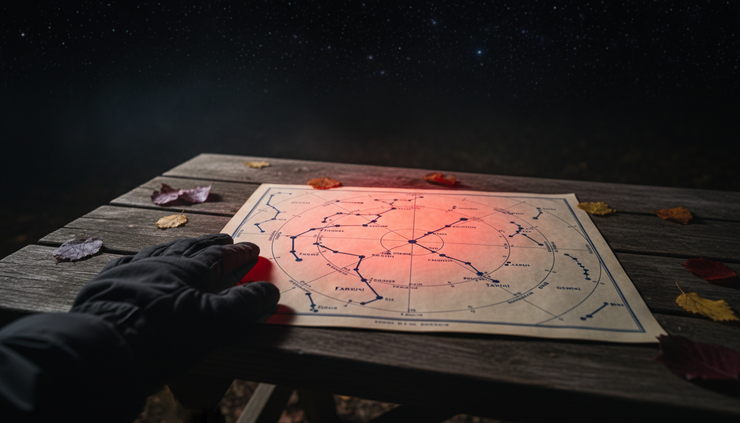
Stargazing tips for amateur astronomers
Meteor watching is one of the easiest forms of astronomy. No telescope is needed. In fact, telescopes and binoculars are usually the wrong tools because they show only a small slice of sky.
The goal is to see as much sky as possible for as long as possible.
Start with comfort. October nights can feel colder than expected, especially when sitting still before dawn. Bring more layers than you think you need. A reclining chair, sleeping pad, or thick blanket can turn a short watch into a productive session.
Give your eyes at least 20 to 30 minutes to adjust to darkness. During that time, avoid white light. If you need a flashlight, use a red one. If you use a phone, dim the screen and turn on red display settings.
Try this simple observing plan:
Arrive before your planned viewing window.
Face away from nearby light domes.
Lie back with as much sky in view as possible.
Let your eyes relax instead of scanning constantly.
Count meteors in 15-minute blocks.
Note bright trails, colors, and trains that linger.
Take breaks to warm up, but keep lights off.
If you want to record observations, keep notes simple. Write down the time, sky conditions, number of meteors seen, and any standout details. For example, note whether a meteor crossed near Taurus, passed overhead, or left a persistent train.
Photography is possible, but it takes patience. Use a camera with manual settings, a sturdy tripod, and a wide-angle lens. Set focus manually on a bright star or distant light before shooting. Use long exposures, but avoid exposures so long that stars trail too much unless that is the effect you want.
A basic starting point for meteor photography is:
Camera setting | Starting point |
Lens | Wide-angle, such as 14 mm to 24 mm |
Aperture | As wide as your lens allows |
ISO | 1600 to 3200, adjusted for your camera |
Exposure | 10 to 20 seconds |
Focus | Manual focus on stars |
Take many frames. Meteors are unpredictable, and most shots will capture only stars. That is normal. A single bright Orionid crossing a familiar constellation is worth the wait.
For families or first-time observers, keep expectations grounded. The Orionids are not usually a “meteor storm.” At a dark site, seeing one meteor every few minutes can count as a good session. Some gaps may last longer. Then two or three may appear close together.
Patience is part of the experience.

The best plan for the 2026 Orionids
The best Orionid plan for 2026 is to treat the peak as a pre-dawn event. Mark the night of October 21 to 22, then check the weather and local moonset time as the date approaches. If the forecast fails, use the broad peak to try a nearby morning.
Choose the darkest safe location you can reach. Bring warm layers, a reclining chair, snacks, and a red light. Skip the telescope, watch a wide patch of sky, and give yourself at least an hour under the stars.
The Orionids are special because they combine a famous comet, a beautiful autumn sky, and the quiet thrill of seeing something small and ancient vanish in a flash of light. In 2026, the Moon may make observers work a little harder, but the reward is still there for those willing to stay up late, look wide, and wait for Orion to rise.

Comments