


Cincinnati’s Most Haunted Spots; 5 Eerie Places, Ghost Stories, and Legends!
Bold Creations by TJ 10/15/2026
Cincinnati does not have to try very hard to feel haunted. The hills rise in dark layers. Old stairways disappear between brick buildings. Cemeteries sit close to theaters, parks, mansions, and river roads. After sunset, the city’s history can feel close enough to brush your shoulder.
Some ghost stories here come from documented tragedy. Others grew from neighborhood whispers, late-night footsteps, cold rooms, and the uneasy feeling that someone unseen is standing nearby. That mix is what makes Cincinnati, Ohio, such a rich destination for ghost enthusiasts and history buffs.
These five haunted locations each carry a different kind of chill, from a concert hall built over old burial ground to a park tied to one of the city’s most infamous murders.
Cincinnati’s haunted history hides in plain sight
Cincinnati grew fast in the 1800s. It became a river city of immigrants, industry, public markets, churches, theaters, breweries, orphanages, and crowded neighborhoods. With that growth came epidemics, accidents, poverty, violence, and burial grounds that were later moved, built over, or forgotten.
That is why so many local ghost stories feel tied to real pieces of the city’s past. They are not just random tales of a floating figure in a hallway. They often circle around places where people gathered in life, places where the dead were buried, or places where sudden loss left a permanent mark.
Cincinnati's most haunted spots also have a very Cincinnati feel. They are layered. A beautiful landmark may have a grim foundation. A peaceful park may preserve a story of scandal. A quiet cemetery may feel more alive after dusk than the street outside its gates.
Music Hall carries the echoes beneath the stage
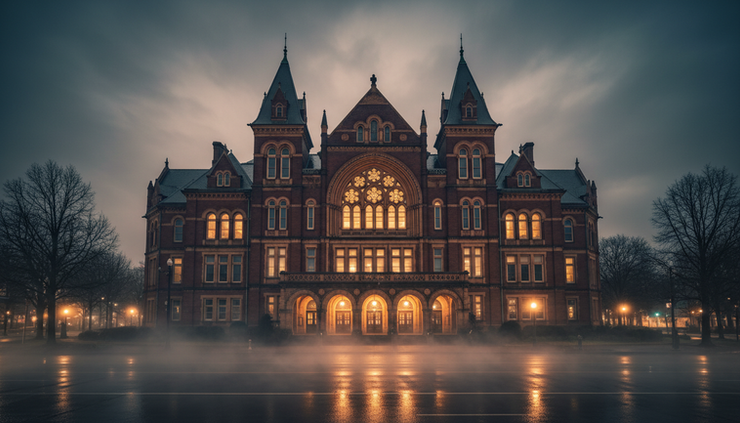
Few buildings in Cincinnati look more haunted than Music Hall. Opened in 1878, its red brick towers and grand arches dominate Over-the-Rhine. It is home to major performances, civic gatherings, and some of the city’s proudest cultural traditions.
It also sits on land long associated with burial grounds and public institutions. During later work at the site, human remains were found, which strengthened the long-standing belief that the building rests above part of the city’s old potter’s field. That history alone gives the place a different weight. The beauty of the hall sits directly on top of loss.
The ghost stories are famous. Staff, performers, and visitors have reported unexplained footsteps, voices in empty rooms, and the feeling of being watched from the balconies. Some tales mention shadowy figures near the stage or backstage areas. Others describe cold spots that seem to gather in places where no draft should be.
One of the most repeated stories involves spectral presences that appear during rehearsals or quiet hours, when the building is nearly empty. The idea fits the hall perfectly. Music Hall is made for sound, and every creak, echo, and distant note can seem like it comes from another century.
The most unsettling part is how normal the building can feel one moment, then changed the next. Visitors often describe a shift in mood, as if the room has suddenly filled with attention. In a theater, applause is expected. At Music Hall, some say the audience never fully left.
Washington Park has bones beneath the grass
Across from Music Hall, Washington Park is bright, public, and often full of life. Families gather there. Dogs race through the grass. Concerts and community events fill the space in warmer months.
Yet the park also has a darker past. Like parts of the surrounding area, the land has ties to old burial grounds. During major renovations, remains were found beneath the park, reminding the city that its public spaces often rest on older, quieter histories.
That makes Washington Park one of the most accessible haunted locations in Cincinnati. You do not have to enter a locked building or join a formal investigation. You can walk the paths, look toward Music Hall, and imagine what the area looked like before today’s lawns and lights.
Local legends tell of strange sensations after dark, including sudden chills, flickers seen at the edge of vision, and uneasy feelings near certain stretches of the park. Some people connect those experiences to the old burial ground. Others think the park’s energy comes from its long life as a gathering place for the living and the dead.
What makes Washington Park eerie is not that it looks frightening. It is that it does not. The ghost story sits under ordinary city life. Picnics, concerts, and playground noise cover the memory of graves, but they do not erase it.

The Sedamsville Rectory is steeped in dread
The Sedamsville Rectory is one of Cincinnati’s most talked-about haunted places. It stands in one of the city’s older west-side neighborhoods and has drawn attention from paranormal investigators, ghost hunters, and curious locals for years.
The building served as a rectory connected to church life, but its later reputation has little of the calm people might expect from a religious residence. Reports from the property often describe a heavy, oppressive feeling. Visitors have claimed to hear disembodied voices, footsteps, knocking, and whispers. Others describe shadow figures, sudden temperature drops, and doors that seem to move without help.
Unlike Music Hall, which feels grand and public, the rectory’s haunted reputation feels close and personal. The stories suggest rooms where the air changes, hallways that do not want company, and corners that seem to hold a presence.
Some local legends link the building to troubled lives, emotional pain, and darker spiritual activity. As with many haunted sites, details can shift depending on who tells the story. What stays consistent is the mood. People who visit often describe the place as uncomfortable before anything even happens.
That may be why the Sedamsville Rectory has remained so compelling. It is not only a place where people report activity. It is a place where the atmosphere itself seems to warn them to leave.
Eden Park is haunted by a real murder
Some Cincinnati ghost stories begin with rumor. The story of Eden Park begins with a documented tragedy.
In 1927, Imogene Remus was killed by her husband, George Remus, a well-known bootlegger whose rise and fall became part of Cincinnati crime lore. The killing happened in Eden Park, and the scandal that followed became one of the city’s most infamous stories from the Prohibition era.
Today, Eden Park is one of Cincinnati’s most scenic places. It offers views of the Ohio River, walking paths, gardens, and landmarks like the Krohn Conservatory and the Cincinnati Art Museum nearby. In daylight, it can feel peaceful and open. At night, the mood changes.
Local legend says Imogene’s ghost still lingers in the park. Some stories place her near the area associated with her death. Others describe a woman in period clothing, a pale figure moving through the trees, or a sudden coldness near quiet paths. Drivers and late-night visitors have reported feeling watched or seeing something vanish before they can fully understand it.
The power of this haunting comes from the blend of beauty and violence. Eden Park is not an abandoned ruin. It is a green, beloved space where a shocking act tore through public life. The ghost story gives that history a face.
Whether one believes Imogene appears there or not, the park holds her story. On a foggy night, with the city lights below and the trees shifting overhead, it is easy to understand why the legend endures.

Spring Grove Cemetery feels alive after dark
Spring Grove Cemetery and Arboretum is one of Cincinnati’s most beautiful historic sites. Founded in the 19th century, it is known for winding roads, lakes, old trees, impressive monuments, and Gothic-style mausoleums. It is also a place where the city’s past feels unusually present.
Many prominent Cincinnati families are buried there, along with veterans, civic leaders, artists, and ordinary residents whose names remain carved in stone. By day, Spring Grove is peaceful and carefully preserved. It is a place for walking, reflection, genealogy, and architecture.
Still, cemeteries gather stories. Spring Grove is no exception.
Visitors have reported unexplained sounds, figures near graves, and the feeling of being followed along certain paths. Some speak of strange lights or shapes seen near mausoleums. Others describe the sense that certain statues seem too watchful, especially when clouds dim the light and the grounds grow quiet.
One reason Spring Grove inspires so many ghost stories is its scale. The cemetery feels like a city of the dead, complete with roads, landmarks, family plots, and stone houses for those who never leave. It is easy to lose track of the modern world there.
The best way to experience Spring Grove is with respect. This is an active cemetery, not a stage set. Walk during permitted hours, keep to paths, and treat graves with care. The eerie feeling is strongest when the place is allowed to speak for itself.
How to explore Cincinnati’s ghost stories with respect
Haunted places are tempting because they let history feel immediate. A name in a book becomes a cold spot. A headline becomes a footstep. A building becomes a witness.
That thrill comes with responsibility. Many of Cincinnati’s ghost stories are tied to real deaths, burials, and grief. Treating these places well keeps the stories from becoming cheap scares.
A few simple rules help:
Check access before you go
Some sites are public, while others are private, restricted, or open only during events or tours.
Do not trespass
A good ghost story is not worth a fine, an injury, or damage to a historic property.
Keep cemeteries peaceful
Stay on paths, avoid touching fragile stones, and follow posted hours.
Listen more than you perform
The most memorable experiences often happen when people are quiet, patient, and aware of the place around them.
Separate history from legend
Both matter, but they are not the same. The truth often makes the ghost story stronger.
Cincinnati’s haunted side is best explored slowly. Start with the public places, like Music Hall, Washington Park, Eden Park, and Spring Grove. Learn the history first. Then, when the air shifts or a sound rises from an empty corner, the moment has somewhere to land.

The stories are still being written
Cincinnati’s ghosts do not belong only to the past. They survive because people keep noticing things they cannot quite explain: a whisper in an empty theater, a figure near a park path, a cold room in an old rectory, a cemetery road that suddenly feels occupied.
That is what makes these places so compelling. They are historic, beautiful, and unsettling all at once.
If you have had your own spooky encounter in Cincinnati, share it. The city’s haunted map grows through stories passed from one person to another, especially the ones told quietly after dark.


Comments